
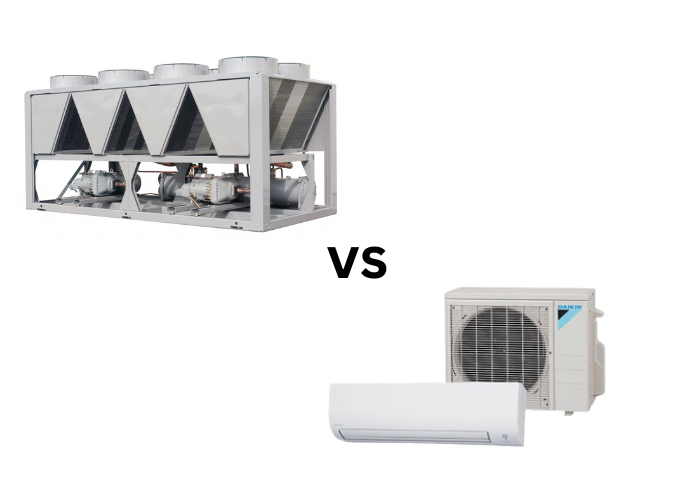
Chillers and split air conditioners are two common HVAC solutions, each suitable for different needs and types of buildings. Choosing between them affects comfort, cost, installation, and long-term efficiency. Therefore, understanding the key differences between chillers and splits is very important.
Introduction to the Systems
It is better to first have a general understanding of chillers and splits, and then compare them.
Chiller
A chiller is a central cooling system that uses refrigerant to produce chilled water and distribute it through piping to fan coil units or air handling units. This technology is ideal for residential towers, hotels, shopping centers, and large office buildings.
Split Air Conditioner
A split air conditioner is a standalone system consisting of an indoor unit (evaporator) and an outdoor unit (condenser), which directly cools the air of a specific space or unit. Splits are the best option for homes, small offices, and single-unit shops.
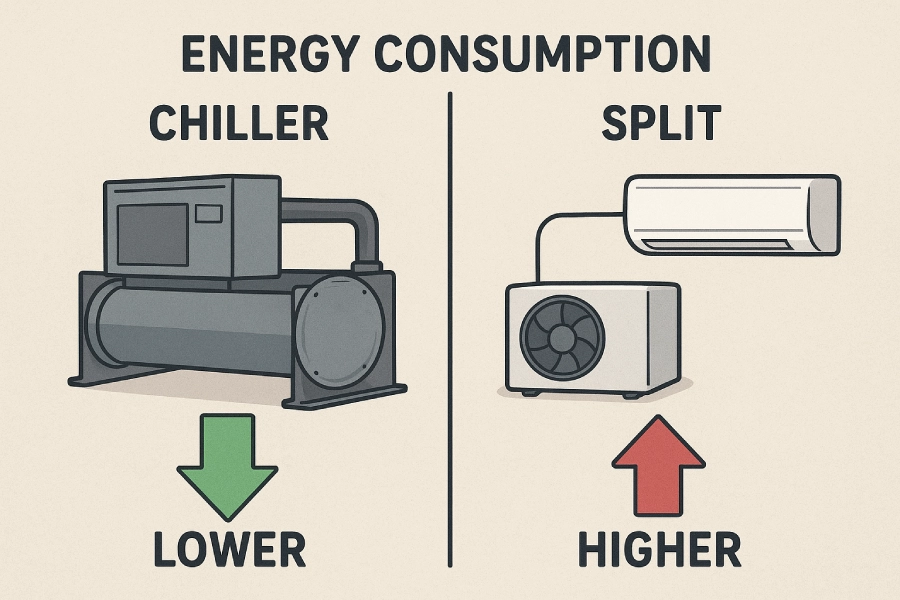
Difference Between Chiller and Split in Energy Consumption
In contrast, a split is suitable for one or a few small units; however, when multiple units are used simultaneously, the overall electricity consumption increases.
Due to its large scale and ability to operate at partial load, a chiller has higher energy efficiency for multi-story and large buildings, resulting in lower electricity costs per unit area.
Installation and Maintenance
A chiller requires professional design and implementation, including piping, pumps, and control systems. Specialized periodic servicing is an integral part of this system, which demands both cost and time.
In contrast, a split system is much simpler to install; the indoor and outdoor units only need to be connected with refrigerant pipes. Installation and maintenance costs are lower, and repairs are performed locally.
Temperature and Humidity Control
With a chiller, precise temperature and humidity control, strong filtration, and even humidification/dehumidification throughout the year—especially when combined with an air handling unit—are possible.
A split system provides good temperature control; however, humidity control is limited and mostly occurs only in cooling mode.
Year-Round Heating and Cooling
A chiller generally provides only cooling and requires a separate boiler or mechanical room for heating. In contrast, many modern split models are equipped with heat pumps that can reverse the refrigeration cycle to provide winter heating. Some models even support connection to hot-water coils for hydronic heating.
Difference Between Chiller and Split in Noise Level
With a chiller, since the equipment is centralized in a mechanical room, indoor noise levels are very low. However, the indoor fan of a split system may generate more noise, although the outdoor unit produces only limited sound.
Independence and Reliability
A chiller is a centralized system, and failure of the main equipment can affect the entire building. In contrast, each split unit operates independently, so a malfunction in one device does not impact other units.
nitial Cost and Lifespan
The initial installation cost of a chiller is higher than that of a split system. However, for large buildings, it is considered cost-effective in the long term as an investment. For smaller spaces, a split system is a more economical option.
Chiller vs. Split at a Glance
| Split Air Conditioner (AC) | Chiller | Feature |
| Independent, direct with refrigerant | Centralized with chilled water | System Type |
| Higher when many units are used | Optimized for large buildings | Energy Consumption |
| Quick and simple | Complex and requires expertise | Installation |
| Limited | Precise and professional | Humidity Control |
| Heat pump or hot-water coil | Requires separate system | Heating Capability |
| Indoor fan noise is higher | Very low inside the building | Noise Level |
| Lower and localized | Higher but centralized | Maintenance Cost |