
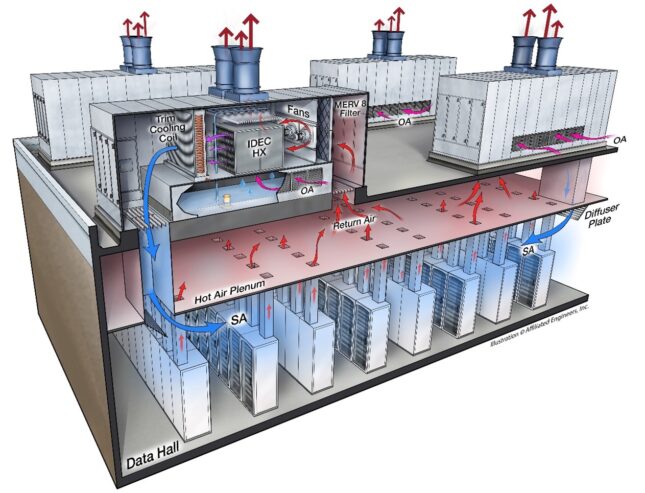
Precise control of temperature and humidity is essential for any data center. High-power servers can generate more than 100 kW of heat per rack, and if that heat is not removed effectively, equipment life shortens, outages become more likely, and the Power Usage Effectiveness (PUE) rises above the desired level. According to ASHRAE standards, the optimal range is 18 to 27 °C with relative humidity between 40 and 60 percent. Achieving these conditions starts with selecting the right cooling strategy.
Computer Room Air Conditioner (CRAC) Systems
One of the most common solutions is the Computer Room Air Conditioner (CRAC). These floor-mounted units draw warm air from the room and cool it using a direct-expansion refrigeration cycle or chilled-water coils, then deliver the cooled air back into the space. Airflow can follow different patterns: in a Down-Flow design cold air is supplied through a raised floor and rises toward the racks; Up-Flow units discharge cold air from the top and pull warm air from below, useful where no raised floor exists; and cool-top configurations place the cooling unit above the rack to remove the heat that accumulates near the ceiling. CRAC systems provide very accurate temperature and humidity control and are easy to scale for small to mid-size facilities, although their energy consumption can be relatively high in ultra-dense environments.
Computer Room Air Handler (CRAH) Systems
For larger installations, Computer Room Air Handlers (CRAH) deliver greater efficiency. CRAH units pass warm return air across chilled-water coils connected to a central chiller plant, then recirculate the cooled air. This approach achieves higher energy performance than CRAC and is ideal for enterprise data centers above one megawatt of IT load, though it requires a chiller, cooling towers, and higher upfront investment.
The main distinction between CRAC and CRAH lies in their source of cooling and overall efficiency. CRAC units typically rely on a self-contained direct-expansion system or an independent chilled-water loop, making them simpler to install and maintain. CRAH systems depend on a centralized chiller, which enables coordinated management and better energy efficiency. As a result, CRAC is often chosen for smaller or medium facilities where flexibility and lower capital cost are priorities, while CRAH is preferred in large, high-density data centers where minimizing energy consumption is critical.
Beyond these two core technologies, an in-room layout is sometimes used. In this approach, cooling units—whether CRAC or CRAH—are placed directly inside the data hall and cool the ambient air without a raised floor. It is a practical choice for retrofits or small facilities where airflow pathways are limited.
In-Row Cooling Systems
For very high-density racks, in-row cooling offers a highly targeted solution. Compact units are positioned between server rows, drawing in the hot exhaust from adjacent racks, cooling it, and returning chilled air directly to the server intakes. Placing the cooling source close to the heat source reduces airflow losses, saves energy, and prevents hot spots, making it well suited to workloads such as AI or machine learning.
Liquid Cooling Systems
The most advanced option is liquid cooling, which replaces air with liquids to transfer heat. It can be implemented through direct-to-chip cold plates, full-server immersion in dielectric fluid, or rear-door heat exchangers mounted on the racks. Liquid systems can manage racks exceeding 100 kW with far less energy than air-based methods, pushing PUE values down to about 1.03.
Which Technology Is More Suitable?
The best choice depends on data-center size, power density, spatial constraints, budget, and sustainability goals. Smaller and mid-size sites often deploy CRAC systems in down-flow, up-flow, or cool-top configurations or adopt an in-room layout. Large enterprise facilities favor CRAH with a central chiller plant, while high-density racks and compute-intensive environments benefit from in-row cooling or liquid cooling. Many advanced data centers combine several of these approaches to balance energy efficiency, reliability, and total cost of ownership.
No comments yet.