
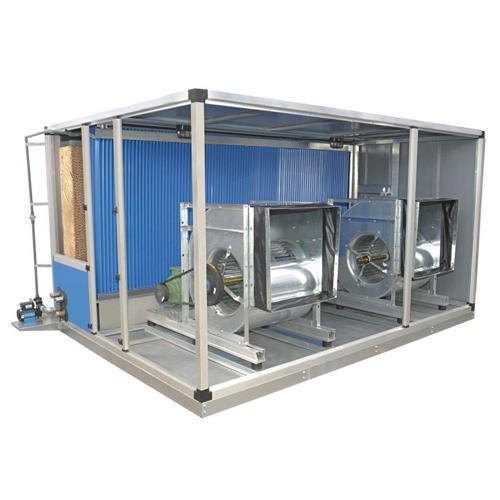
The Zent (Zent) unit is one of the widely used devices in the HVAC field, providing fresh and comfortable air for various spaces by combining an evaporative cooling system with direct heating. This device is essentially a type of evaporative air handling unit (Evaporative AHU) which, due to its low energy consumption and easy maintenance, is commonly used in office buildings, industrial facilities, commercial centers, and residential spaces.
The Zent operates somewhere between an evaporative cooler and an air handling unit; meaning, similar to an evaporative cooler, it uses evaporative cooling to lower the air temperature, but unlike it, the Zent is also capable of heating and offers more precise control over airflow and air quality. During cold seasons, the air passing through the unit is heated using a hot water coil or a gas heater before being delivered to the environment.
Structure and Components of the Zent Unit
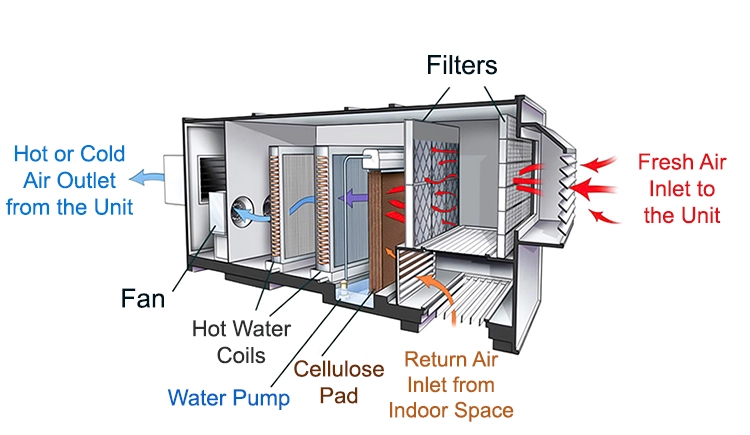
The Zent device consists of several main sections, each playing a specific role in the ventilation process:
1. Air Filter Section
At the inlet of the device, aluminum or polyester filters remove suspended particles and dust to ensure clean and healthy incoming air.
2. Evaporative Cooling Section
This section is the core of the Zent. Here, water is sprayed onto the passing air through nozzles or cellulose pads. As the water evaporates, the air temperature drops, resulting in cooling.
3. Fan or Blower
In the Zent unit, the cooled or heated air is delivered to air ducts and ultimately to the space through a fan. (You may also want to read a brief article about cooling towers.)
4. Heating Section
This section usually includes a hot water coil or a gas heater. In winter, the air passing through this section is heated, providing a comfortable temperature for the environment.
5. Inlet and Outlet Dampers
The dampers are used to regulate the amount of fresh air and return air coming from the environment.
Operating Principle of the Zent Unit
The Zent operates based on evaporative cooling in summer and direct or indirect heating in winter. In cooling mode, water is passed over wood pads or cellulose pads, and part of it evaporates. This process absorbs the sensible heat from the air and reduces its temperature. The cooled air is then directed into the building by the fan.
In heating mode, the water and pad system is deactivated, and the air passes through the heating section. If the unit is connected to a hot water coil, hot water from a boiler or package unit enters the coil and heats the passing air. In gas-fired models, the burner directly heats the incoming air.
Advantages of the Zent Unit
Due to its simple design and the combination of both heating and cooling functions, the Zent is highly economical and energy-efficient.
- Low energy consumption: Compared to compression-based systems, the Zent consumes much less electricity and energy since it relies on the evaporation of water.
- Fresh air supply: Unlike an evaporative cooler, the Zent can mix a portion of outdoor fresh air with return air, improving indoor air quality.
- Dual-season operation: A single device can provide both cooling and heating needs.
- Low maintenance cost: The Zent consists of simple, easily available parts, and its periodic servicing is straightforward.
Disadvantages and Limitations
Although the Zent is efficient, it does have limitations under certain conditions. The most significant issue is its dependence on ambient humidity for cooling performance. In regions with high humidity, water does not evaporate effectively, leading to reduced cooling efficiency. Additionally, precise control over temperature and humidity—like that offered by compression systems such as chillers and AHUs—is not possible with this device.
Types of Zent Units
Zent systems are categorized into several groups based on the type of heat exchanger and installation method:
- Zent with hot water coil: Connected to a boiler or a package unit; suitable for residential and office buildings.
- Gas-fired Zent: Equipped with a gas burner for direct heating; ideal for halls and workshops.
- Cellulose-pad Zent: Uses cellulose pads instead of wood pads, providing higher evaporative efficiency.
- Ducted or rooftop Zent: Used in large spaces or for supplying multiple rooms simultaneously.
Difference Between the Zent Unit and an Evaporative Cooler
An evaporative cooler is used only for cooling and cannot provide heating or humidity control, whereas the Zent is a complete ventilation system with dual-season functionality. The Zent is also typically equipped with ductwork and filters, supplying cleaner and fresher air.
Applications of Zent Units
Due to their low installation costs and combined heating/cooling performance, Zent units are widely used in:
- Office, educational, and commercial buildings
- Industrial halls and workshops
- Public spaces such as mosques and sports centers
- Villas and large residential projects
No comments yet.